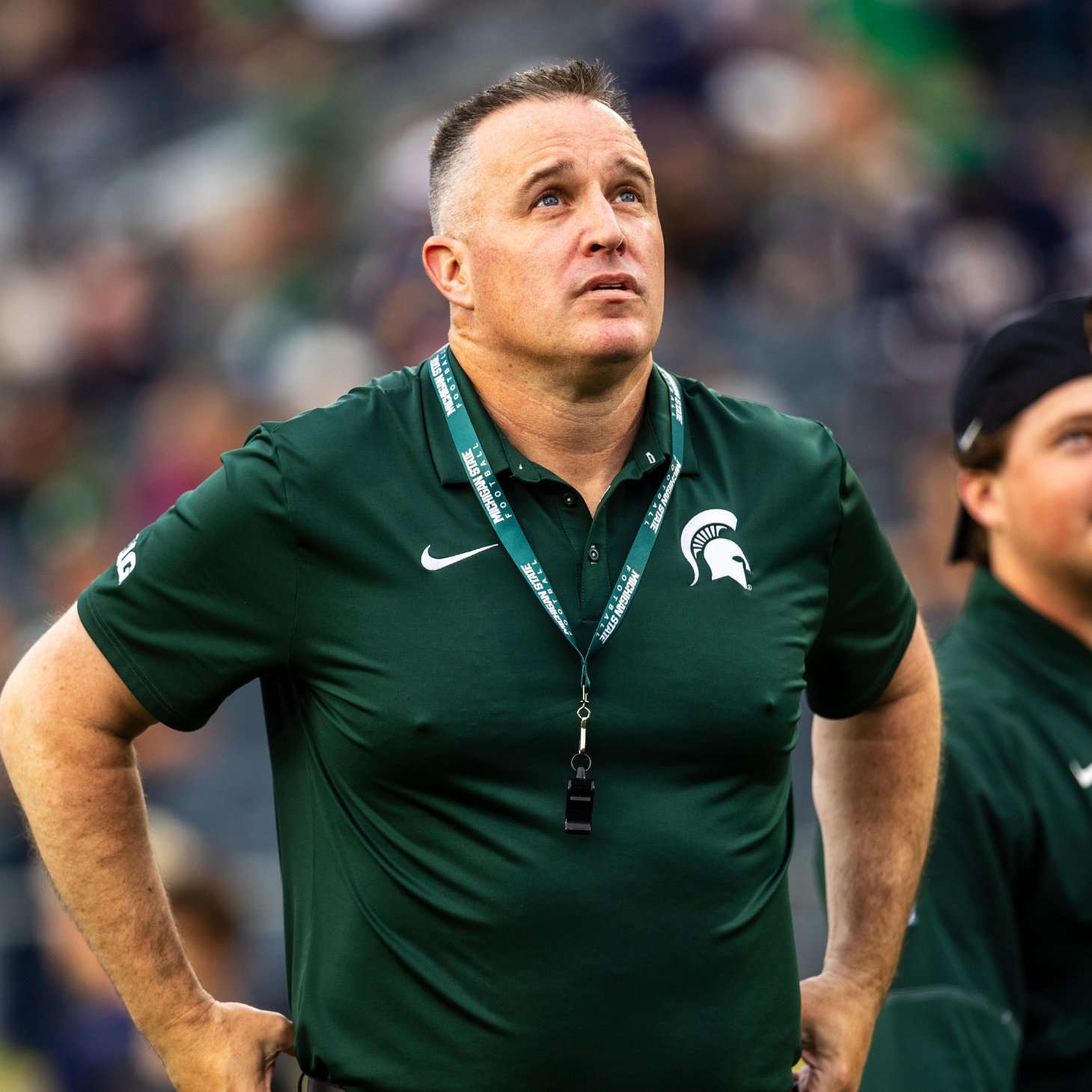
SOUTH BEND — The scoreboard told one story.
The scene after the final whistle told another.
Michigan State had just suffered a painful 27–10 defeat to No. 3 Notre Dame at Notre Dame Stadium, a game that remained within reach at halftime before slowly slipping away from the Spartans over a frustrating second half.
Notre Dame celebrated. Michigan State stood in silence.
For the Spartans, there were no points after halftime, no dramatic comeback and no late miracle.
There was only the difficult walk toward the tunnel and the realization that a night filled with possibility had ended in disappointment.
But before Michigan State disappeared from the field, head coach Pat Fitzgerald stopped his players.
What followed became the emotional image of the night.
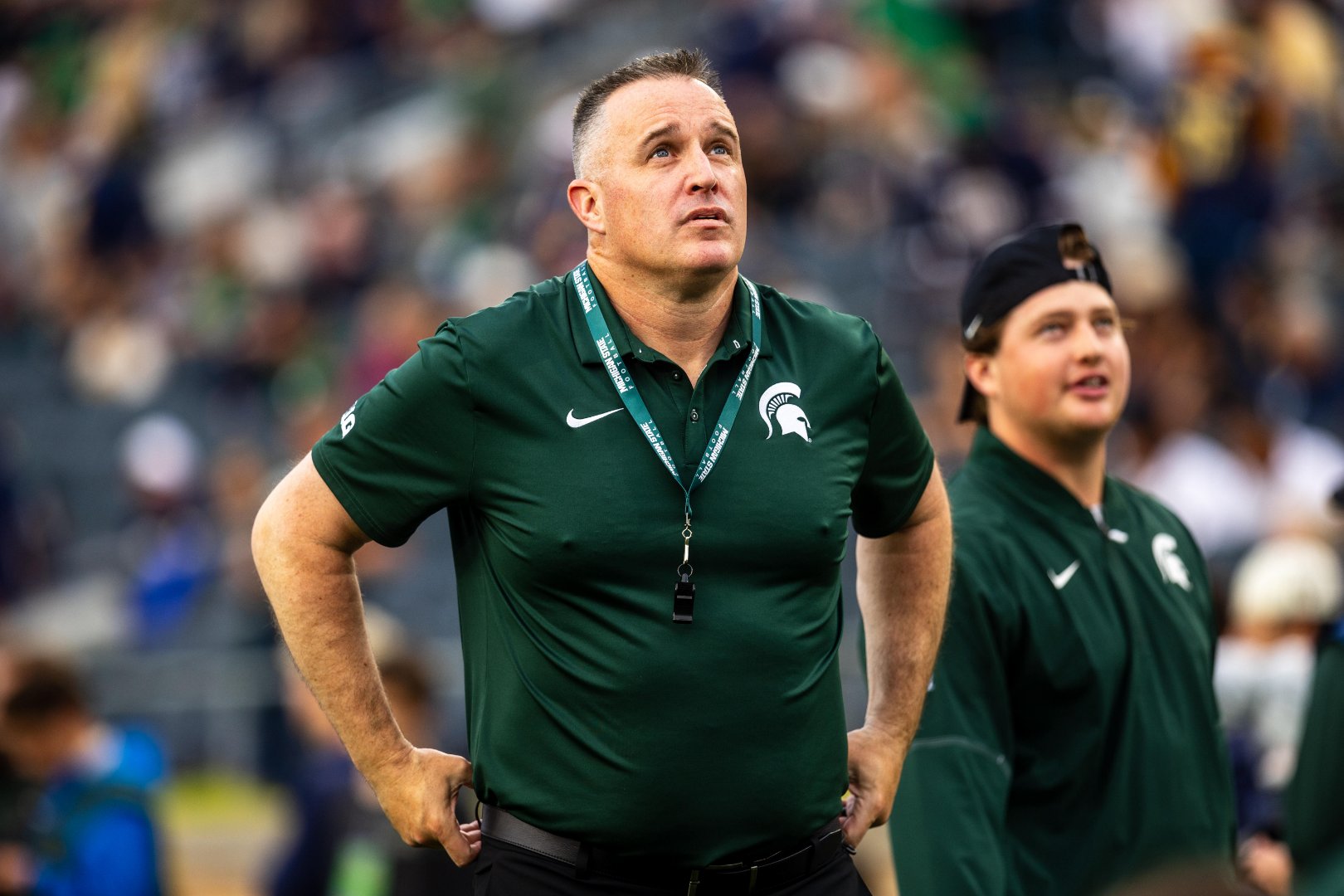
A Fight That Slowly Slipped Away
Michigan State entered South Bend knowing exactly what was waiting.
Notre Dame was unbeaten, highly ranked and playing inside one of college football’s most recognizable stadiums.
From the opening minutes, the Fighting Irish played like a team determined to protect its home field.
Notre Dame struck first and eventually established a 10–0 advantage.
Michigan State could have folded.
Instead, the Spartans responded.
A field goal finally put points on the board, and later in the second quarter, Cam Fancher broke free for a 15-yard touchdown run, giving Michigan State its biggest surge of energy all night.
Suddenly, it was 17–10.
The Spartans had life.
The Michigan State sideline erupted. Players jumped from the bench. Coaches shouted instructions.
The small but passionate group of green-and-white supporters inside Notre Dame Stadium finally had reason to believe.
At halftime, Michigan State was down only seven.
One touchdown could change everything.
But after the break, Notre Dame took control.
The Fighting Irish defense became suffocating. Running lanes disappeared. Passing windows closed. Michigan State possessions became shorter and increasingly desperate.
Notre Dame, meanwhile, kept moving the chains and draining the clock.
A third-quarter field goal stretched the margin to 20–10.
Then came the final blow.
With 11:09 remaining in the fourth quarter, Notre Dame quarterback CJ Carr crossed the goal line on a three-yard touchdown run.
27–10.
Michigan State never recovered.
The Spartans finished with only 167 total yards, compared with Notre Dame’s 395.
They committed two turnovers and were held scoreless for the entire second half.
When the final seconds disappeared, the result was undeniable.
Notre Dame had won.
Michigan State had been beaten.
But the night wasn’t quite over.
Fitzgerald Stops His Team
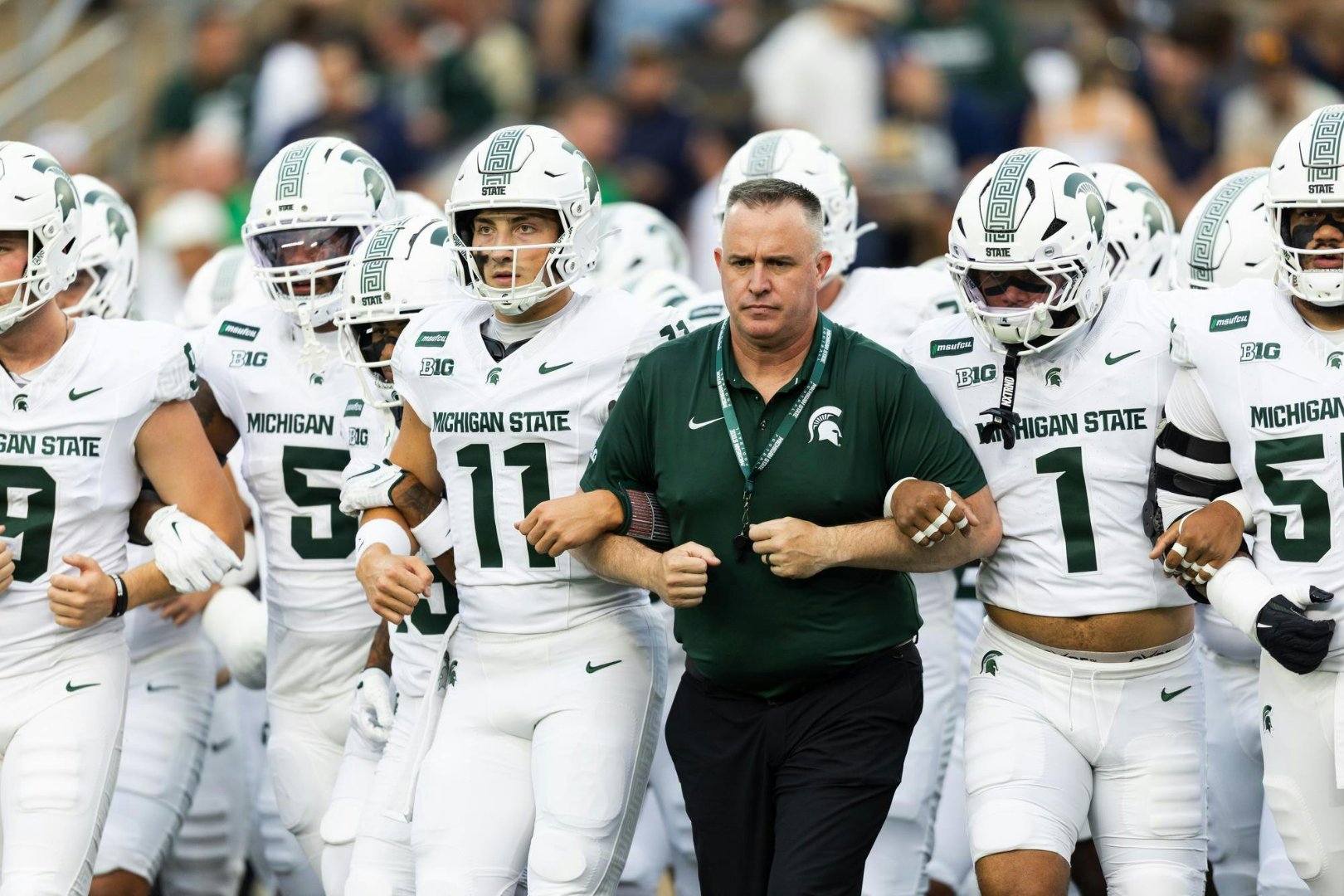
As Notre Dame players began celebrating and the stadium buzzed around them, Michigan State players slowly started moving toward the sideline.
Some stared at the turf.
Others removed their helmets.
There were few words.
Then Fitzgerald stopped them.
Instead of allowing the team to immediately disappear into the tunnel, the Michigan State coach called his players back together.
Offense.
Defense.
Special teams.
Everyone.
He brought them into a tight group and stood among them.
Then he turned toward the Michigan State supporters who had remained in the stands.
They had traveled to South Bend hoping to witness an upset.
They had screamed when Michigan State pulled within seven.
They had watched Notre Dame gradually take control.
And even with the scoreboard showing 27–10, many of them had stayed.
That was when the emotional moment began.
Fitzgerald stepped forward.
There was no furious speech.
No attempt to pretend the defeat did not hurt.
He simply looked toward the Michigan State section and began:
“GO GREEN!”
For a moment, the response was scattered.
Then it came back.
“GO WHITE!”
Fitzgerald repeated it.
“GO GREEN!”
This time, more voices answered.
“GO WHITE!”
Players began locking arms.
A few raised their helmets toward the stands. Others stood motionless, absorbing the scene.
The chant grew.
Not because Michigan State had won.
Not because there was anything to celebrate about the scoreboard.
But because, in that moment, the chant meant something different.
It meant they were still together.
More Than a Chant
There is something easy about celebrating victory.
The difficult moments reveal something else.
Michigan State had come to South Bend believing it could make a statement.
Instead, the Spartans walked away with their first defeat of the season and plenty of questions about an offense that struggled badly after halftime.
Fitzgerald did not attempt to hide from that reality.
He stood directly inside it.
The coach looked toward the fans, then back toward his players.
The disappointment was visible.
But so was the connection.
“GO GREEN!”
“GO WHITE!”
For those few minutes, the final score almost felt secondary.
The chant became an acknowledgment of the people who had made the trip, the players who had spent months preparing for nights like this, and the reality that a season is rarely defined by one Saturday.
There would be time to review the interceptions.
Time to examine the offensive struggles.
Time to ask why Notre Dame controlled possession for more than 37 minutes.
Time to study how CJ Carr completed 18 of 24 passes for 234 yards, how Nolan James Jr. rushed for 121 yards and how Micah Gilbert tore through Michigan State’s secondary for 170 receiving yards.
Those questions mattered.
But they could wait.
For that moment, Fitzgerald wanted his players looking up rather than down.
The Pain Michigan State Must Carry Forward
Michigan State’s defeat exposed weaknesses that cannot simply be ignored.
Quarterback Alessio Milivojevic completed nine of 17 passes for 123 yards but threw two interceptions.
Cam Edwards was limited to 38 rushing yards on 12 attempts.
The Spartans struggled to sustain drives, and once Notre Dame established control in the second half, Michigan State could never truly seize it back.
Those are problems Fitzgerald and his staff will have to confront.
But adversity can become part of a team’s identity too.
The question is what happens next.
Does a 27–10 loss become the night Michigan State begins to doubt itself?
Or does it become the night the Spartans remember when the season gets difficult again?
That was what made the postgame scene feel so powerful.
Fitzgerald wasn’t celebrating defeat.
He was reminding his players that defeat did not have to become surrender.
The Scoreboard Goes Dark, the Chant Remains
Eventually, the players separated.
Notre Dame’s celebration continued elsewhere.
Michigan State began its walk toward the locker room.
The scoreboard still showed the truth:
NOTRE DAME 27.
MICHIGAN STATE 10.
Nothing could change that.
But as the Spartans finally disappeared from the field, the last echoes from their supporters carried through the stadium.
“GO GREEN!”
“GO WHITE!”
Football seasons are remembered for championships, rivalry victories and unforgettable plays.
Sometimes, however, teams discover who they are after the celebration belongs to somebody else.
Michigan State lost the football game in South Bend.
The Spartans lost their unbeaten record.
But in those emotional minutes after the final whistle, Fitzgerald made sure his players understood that they had not lost each other.
The pain was real.
The disappointment was real.
And the defeat was real.
But so was the message.
The season continues.
The fight continues.
And after one of Michigan State’s most difficult nights of the young season, one chant remained:
GO GREEN. GO WHITE.