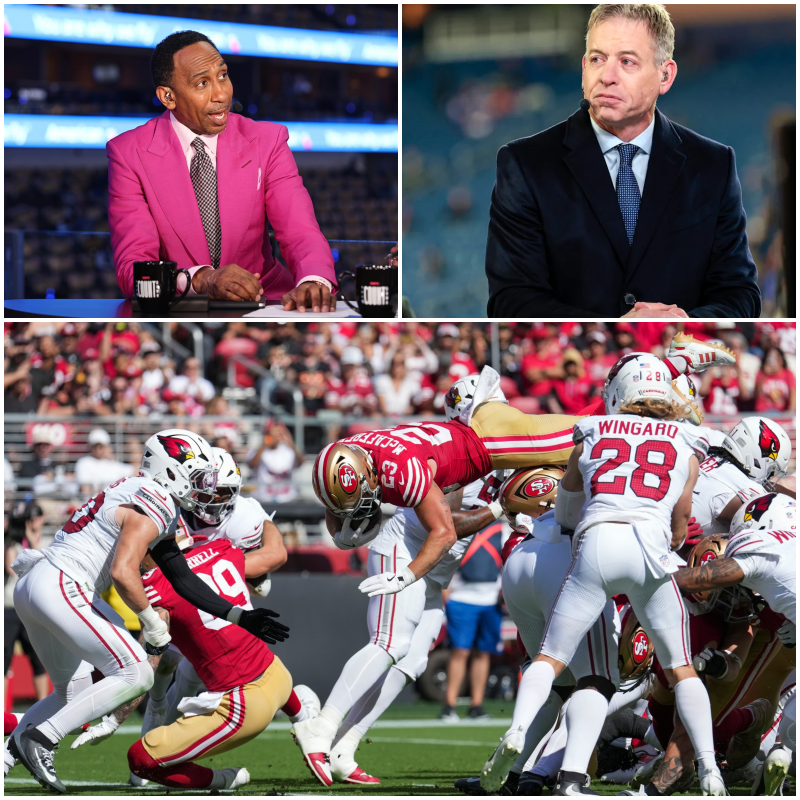
The San Francisco 49ers’ dramatic 36–30 victory over the Arizona Cardinals already had NFL fans arguing about officiating, execution, and which team truly deserved to walk away with the win. But in a fictional postgame studio scenario built around that debate, the tension reached another level when Stephen A. Smith and Troy Aikman found themselves on completely opposite sides of the argument.
What started as a routine discussion about San Francisco’s performance quickly turned into a fiery exchange.
Stephen A. Smith opened the debate by questioning whether the 49ers had actually played well enough to deserve the victory.
“Don’t tell me San Francisco won this game because they played well,” Smith said. “They won because too many officiating decisions went in the 49ers’ favor. This team played terribly at several points, lacked chemistry, and Arizona was actually the team that impressed me more.”
The comment immediately changed the atmosphere inside the studio.
Smith’s criticism centered on the idea that San Francisco had benefited from controversial calls while Arizona was forced to fight through penalties and difficult situations throughout the game. The Cardinals had mounted a strong second-half comeback and repeatedly threatened to erase the 49ers’ advantage.
But Troy Aikman strongly disagreed with the suggestion that San Francisco’s victory should be reduced to officiating.
Before Smith could completely finish his point, Aikman slammed his hand down on the desk.
“What do you even know about the San Francisco 49ers to say that?” Aikman shouted.
The studio suddenly went quiet.
Aikman then pointed directly toward Brock Purdy’s performance as evidence that San Francisco had earned the victory through execution when the pressure was at its highest.
“Didn’t you see how Brock Purdy played?” Aikman continued. “Every single time Arizona closed the gap, Purdy had an answer. When the Cardinals applied pressure, he stayed calm and responded. That is not what a team with no chemistry looks like.”
That argument captured one of the biggest storylines of the game.
Arizona repeatedly threatened San Francisco in the second half. The Cardinals cut into the lead and put pressure on the 49ers to respond offensively. Purdy, however, continued making important plays when San Francisco needed them most.
His connection with George Kittle became especially important late in the game.
Whenever Arizona appeared close to completely changing the momentum, San Francisco managed to produce another scoring drive.
For Aikman, that was the definition of composure.
Smith remained unconvinced.
He shook his head and quickly fired back.
“No, Troy. That was just luck and officiating decisions,” Smith said. “Don’t turn a few good throws into proof that the entire team played great.”
That response appeared to push Aikman even further.
For several seconds, he said absolutely nothing.
His expression changed.
The energy around the desk suddenly felt different as the other analysts waited to see what would happen next.
Aikman stared directly at Smith.
Then he delivered a 15-word response:
“Purdy answered every challenge tonight; blaming officials only proves you never understood this game properly.”
The remark brought the discussion to an immediate halt.
Smith stayed silent for a moment while the other analysts looked at one another.
The imaginary studio audience also went quiet before the discussion eventually resumed.
The confrontation reflected the larger debate surrounding the game itself.
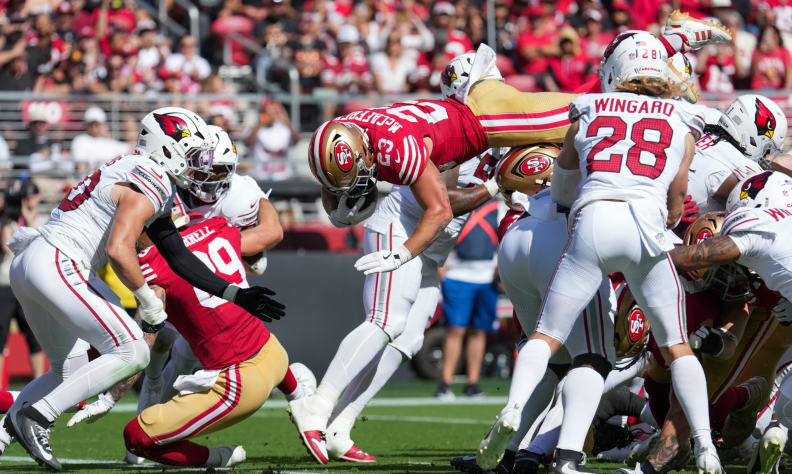
San Francisco supporters could point toward Purdy’s calm performance, Christian McCaffrey’s production, George Kittle’s late touchdowns, and the 49ers’ ability to answer every Arizona scoring run.
Cardinals supporters, however, had reasons to be frustrated.
Arizona committed numerous penalties, including offensive pass interference calls that became major talking points. Those moments contributed to questions about whether the Cardinals had been prevented from building offensive rhythm at important stages of the contest.
Still, Arizona also had opportunities to overcome those problems.
The Cardinals repeatedly reached scoring territory and managed to turn what once looked like a comfortable San Francisco advantage into a one-score game.
That comeback made the final minutes particularly intense.
For Smith’s side of the fictional debate, those circumstances raised questions about whether the 49ers had truly controlled the game.
For Aikman’s side, however, surviving that comeback was exactly what made San Francisco’s performance impressive.
Winning in the NFL does not always require domination from the opening whistle to the final snap.
Sometimes it requires responding under pressure.
That was the central point of Aikman’s argument.
Purdy did not need San Francisco to play flawless football around him. He simply needed to make the necessary throws when Arizona threatened to take control.
And he repeatedly did.
The fictional clash between Smith and Aikman therefore became about something larger than officiating.
It became a debate about what defines a deserving winner.
Does a team lose credibility because controversial penalties work in its favor?
Or should the focus remain on whether that team capitalizes on opportunities and executes when the game is on the line?
San Francisco ultimately finished with the only statistic that cannot be debated: a 36–30 victory.
But the arguments surrounding how the 49ers achieved that result are unlikely to disappear quickly.
If anything, a heated debate like this perfectly reflects how divided fans can become after a close, emotional NFL game.
And one question remains at the center of it all:
Did the San Francisco 49ers win because they were the better team when it mattered most — or did officiating play too large a role in Arizona’s defeat?